How to Give an AI Script a Personality So the Video Sounds Like Somebody
There is a particular kind of video that is impossible to complain about and impossible to remember. The edit is clean, the voice is smooth, the facts are right, and thirty seconds after it ends you could not say which channel made it. I have published that video. Most people working with AI drafts have.
The problem is not that a model writes badly. It writes fluently, which is worse, because fluency is what lets a script get all the way to a recording without anybody noticing that nobody is in it.
What follows is how I make AI scripts sound human on faceless channels — a voice sheet, a prompt that carries it, and a rewriting pass that takes about twenty minutes per video.
Why a generated draft reads as nobody’s
Ask a model for a script and you get the average of everything ever written on the subject. That is what it is for. The average is smooth, balanced, hedged, and stripped of the two things that make writing feel like it came from a person: specificity and stance.
Viewers do not consciously detect the tool. They notice an absence — nothing risky, nothing anyone could disagree with, no detail that could only have come from one particular person on one particular day. It reads like a summary of the topic rather than somebody talking about it.
Which means the fix is not “sound more casual”. Contractions and exclamation marks do not help. The fix is to put something in the script that only you could have put there.
The voice sheet
Write this once per channel. Eight lines, half a page, and it does more for tone than any amount of prompt tinkering.
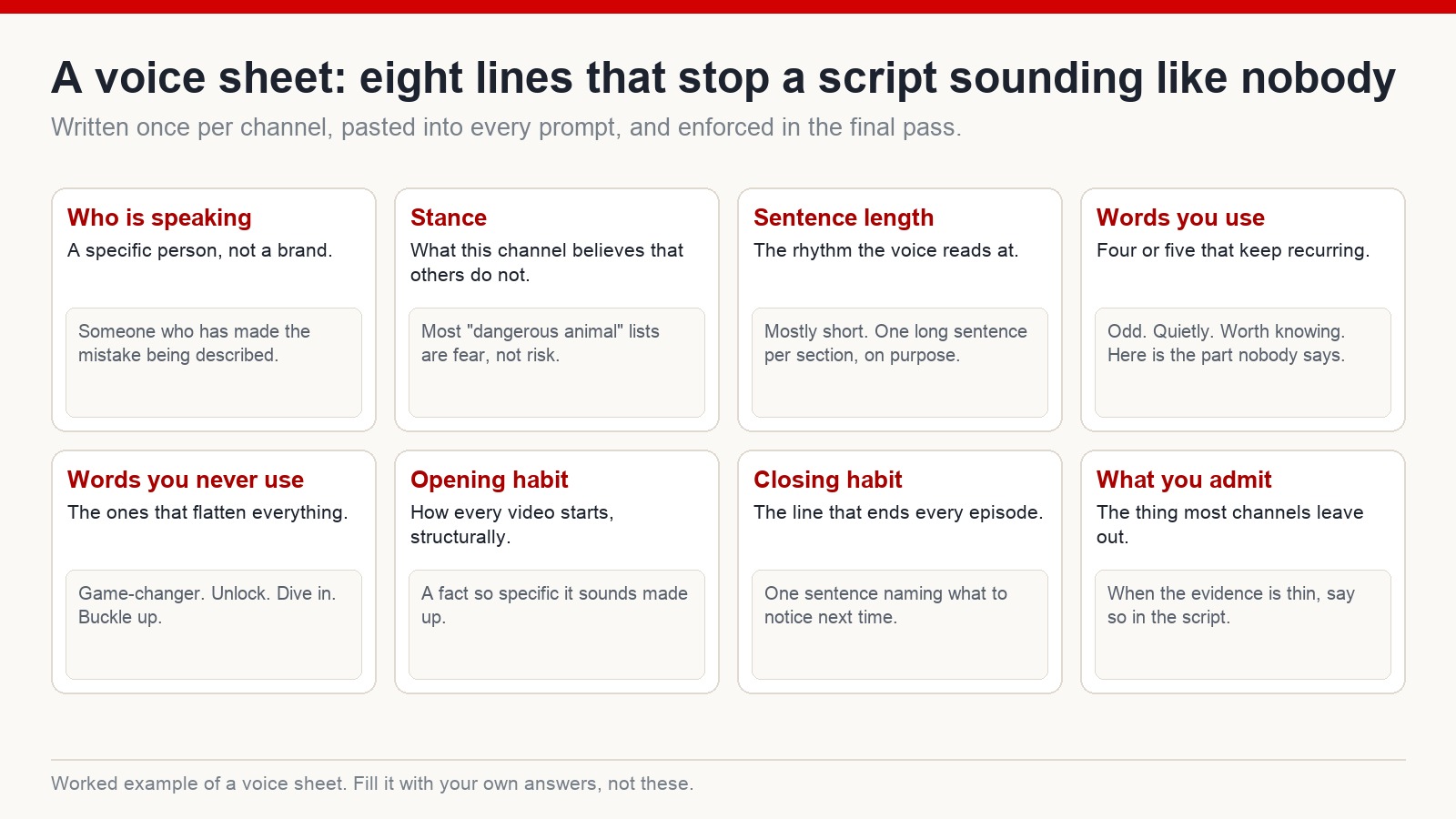
Two of these fields carry most of the weight, so they are worth doing carefully.
Stance is what this channel believes that others in the niche do not. It can be mild. “Most ‘dangerous animal’ lists are about fear rather than risk” is a stance. “We explore fascinating animals” is not — it is a category. A stance gives every video an angle to be written from, which is exactly what a model cannot invent for you.
Words you never use is the fastest quality filter I know. Write down the vocabulary that flattens everything — game-changer, unlock, dive in, buckle up, in today’s video, without further ado, let’s get into it — and treat their appearance as a defect. Half of what makes generated narration feel generic lives in about twenty phrases.
The prompt that carries it
The voice sheet is only useful if the model sees it every time. This is the wrapper I use, with the sheet pasted into it. Fill the bracketed parts with your own answers, not the example ones.
You are drafting narration for a faceless YouTube video. Write it to be spoken aloud, not read.
Voice sheet
Speaker: [a specific person, e.g. someone who has made the mistake being described]
Stance: [what this channel believes that others do not]
Rhythm: [e.g. mostly short sentences, one long one per section]
Recurring words: [four or five]
Banned words and phrases: [your list]
Opening habit: [how every video starts, structurally]
Closing habit: [the line that ends every episode]
Admits: [what this channel says out loud when the evidence is thin]Rules
1. Every section must contain at least one concrete, checkable detail — a place, a number, a date, a name. No general statements standing alone.
2. Take a position where the material allows one, and say so in the first person.
3. Where the evidence is uncertain, say it is uncertain rather than smoothing over it.
4. No line may begin with “In this video”, “Let’s dive in” or any phrase on the banned list.
5. Mark with [SOURCE?] any claim you are not confident about, so I can check it before recording.
6. Do not write a conclusion that restates the video. End on the closing habit above.Task
Draft section [n] of [m]: [what this section has to do for the viewer]. Target roughly [x] spoken words. Return the narration only.
Rule five is the one people leave out and then regret. A model will state something uncertain with total confidence; asking it to flag its own shaky claims turns twenty minutes of fact-checking into five.
The voice pass
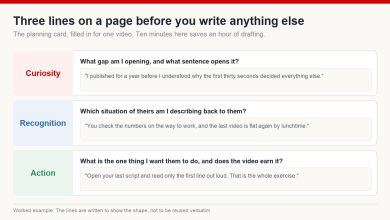
Even with a good prompt, the draft comes back partly anonymous. The pass is one read-through with one question: would anybody know I wrote this?
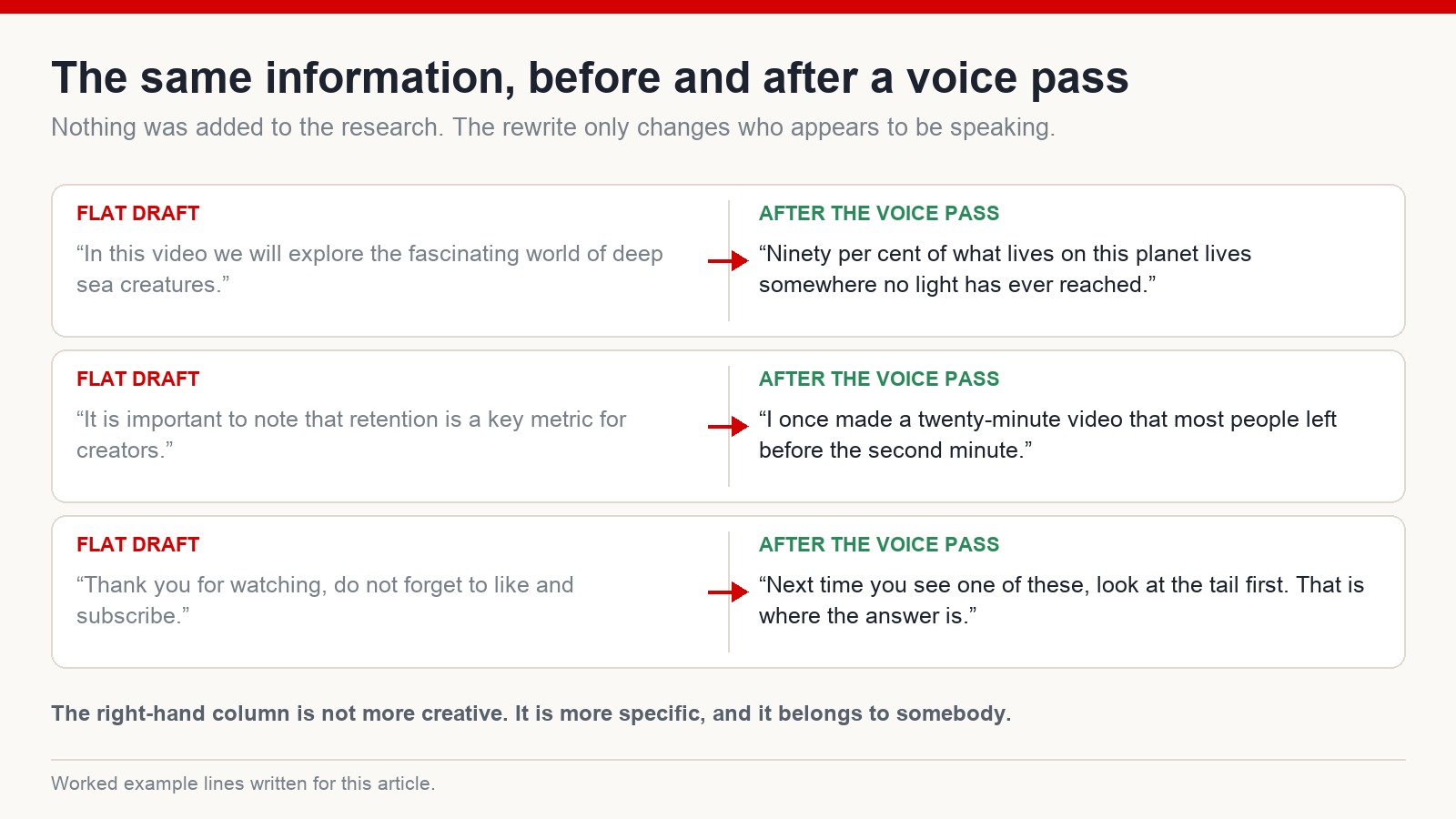
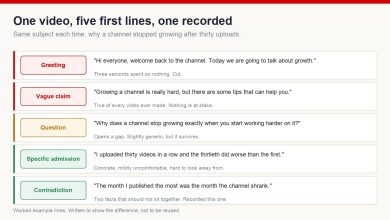
Notice what changed in those pairs. Nothing was added to the research. The right-hand lines are not more creative — they are more specific, and they belong to somebody. That is the whole move.
A workable quota: one paragraph in three has to contain something a model could not have produced. A mistake you made. A number from your own dashboard. A thing you noticed that nobody else mentions. A judgement somebody could argue with.
Personality without a face
Faceless does not mean anonymous. It means the identity lives in the writing and the sound rather than in a camera, which if anything makes it more deliberate work, not less.
Three places it accumulates:
- A structural opening habit. Not a catchphrase — a shape. Every video starts with a fact so specific it sounds invented, or with the moment things went wrong, or with the question everyone gets backwards. Repetition of shape is what makes a channel recognisable in three seconds.
- A closing habit. Most faceless videos end with “thanks for watching”, which is the sound of nobody. Replace it with one sentence that does something: name what to look for next time, or admit what the video could not answer. “Next time you see one of these, look at the tail first. That is where the answer is.”
- Admissions. Saying “I could not find a straight answer to this” is worth more trust than any amount of confident narration, and no competitor’s script will have it.
Asking for a response, without the bait
The obvious way to invite comments is the numbered prompt — “comment 1 if this happened to you”. Avoid it. It is engagement bait, it breaks the platform’s spam policy, and the comments it produces are worthless to read.
A question in your actual voice does the same job honestly: “If you have run into this, I want to know what it was — I read them.” It fits the channel, it invites something real, and it does not put the video at risk to move a number.
Learning from a competitor without becoming one
Study the structure, the pacing, the psychology of why a video held people. Then tell it in your own voice with your own material. The moment your script starts matching somebody else’s running order and examples, personality is not the only thing you have lost — that is reused content, and it is a policy problem as well as a creative one.
Frequently asked questions
Does AI make a channel sound generic? Only when it is the last step. Used for research, outlines and first drafts, then rewritten by you, it saves time without removing the person.
Does personality matter on a faceless channel? Yes, and arguably more. With no face on screen, the writing and the voice are the only places an identity can live.
How much of a script should I rewrite? Enough that roughly a third of it contains something only you could have written. In practice that is twenty minutes on a ten-minute video.
Should the narrator be me, or a character? Either, as long as it is consistent. What audiences dislike is not a persona — it is the absence of one.
Where to start
Write the voice sheet before you write anything else this week. Then take the last script you published, count how many paragraphs contain something only you could have written, and rewrite until a third of them do. It is the cheapest change available and the one people notice.
If you want the whole scripting and production process behind this for faceless channels aimed at international audiences, it is at mmoyoutube.com. Results vary and platform policies change.